When your electric golf cart won’t start, your e-bike loses power mid-ride, or your solar battery bank sits depleted, the culprit often isn’t the battery itself—it’s an inadequate or failing 48v battery charger. Choosing the right charging solution can mean the difference between years of reliable service and costly premature battery replacement. In the rapidly evolving world of electric vehicles, renewable energy systems, and industrial equipment, 48-volt systems have emerged as the sweet spot for balancing power delivery with safety and efficiency.
Whether you’re powering a fleet of warehouse forklifts, maintaining an off-grid solar installation, or simply keeping your electric scooter ready for daily commutes, understanding what makes a quality 48v battery charger is essential for protecting your investment and ensuring optimal performance.
Understanding 48V Battery Systems and Why They Need Specialized Chargers
The 48-volt electrical architecture has become the industry standard across diverse applications, from electric vehicles to telecommunications backup systems and renewable energy storage. This voltage level strikes an optimal balance between power delivery capability and electrical safety regulations, sitting just below the 50-volt threshold that triggers more stringent safety requirements in most jurisdictions.
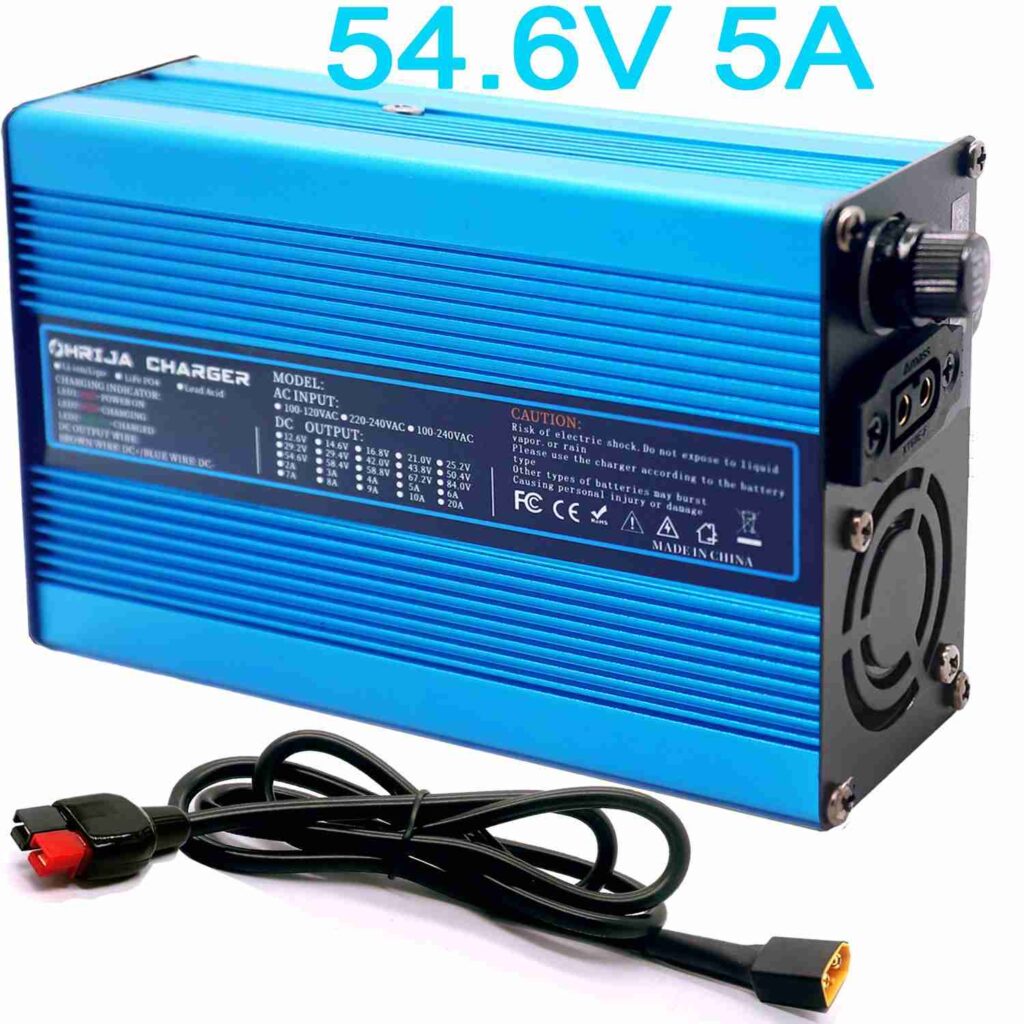
A 48v battery charger must be specifically engineered to handle the unique charging profiles of these systems, which typically consist of either four 12-volt batteries connected in series, sixteen 3-volt lithium cells, or specialized 48-volt lithium iron phosphate (LiFePO4) battery packs. The voltage requirements are precise—charging voltages typically range from 54.6 volts for lithium-ion systems to 58.4 volts for lead-acid configurations—and using an improperly matched charger can result in undercharging that diminishes capacity or overcharging that permanently damages cells and creates safety hazards.
Battery chemistry fundamentally dictates charging requirements, with lead-acid, lithium-ion, and lithium iron phosphate batteries each demanding distinct charging algorithms. Lead-acid batteries require a three-stage charging process consisting of bulk charging at constant current, absorption charging at constant voltage, and float maintenance charging to prevent self-discharge. Lithium-based batteries need constant current/constant voltage (CC/CV) charging with precise voltage regulation and built-in battery management system (BMS) communication for cell balancing.
Modern 48v battery chargers incorporate microprocessor control and sophisticated charging algorithms that automatically detect battery chemistry and adjust parameters accordingly, preventing the common mistakes that shorten battery lifespan. According to research published by the Battery University, proper charging can extend battery life by 300-500% compared to improper charging methods, making charger selection one of the most cost-effective maintenance decisions for 48-volt systems (Battery University, 2024).
Types of 48V Battery Chargers: Matching Technology to Your Application
The landscape of 48v battery charger technology encompasses several distinct categories, each optimized for specific use cases and battery chemistries. Standard onboard chargers are permanently installed in vehicles and equipment, providing convenient charging without removal of batteries. These units typically range from 5 to 25 amps output, with higher amperage models reducing charging time but generating more heat and potentially reducing battery longevity if not properly managed. Portable bench chargers offer flexibility for workshop environments and multi-vehicle applications, allowing a single high-quality charger to service multiple batteries. Industrial opportunity chargers deliver rapid charging during short break periods, enabling continuous equipment operation in demanding applications like warehouse logistics and manufacturing.
Smart chargers represent the technological pinnacle of battery charging, incorporating microprocessor control, multiple charging algorithms, temperature compensation, and often Bluetooth or WiFi connectivity for remote monitoring. These advanced 48v battery chargers can detect sulfation in lead-acid batteries and execute desulfation pulses to restore capacity, monitor individual cell voltages in lithium battery packs, and automatically switch to maintenance mode when charging completes. Solar MPPT (Maximum Power Point Tracking) chargers optimize charging from photovoltaic panels, adjusting their input characteristics to extract maximum available power regardless of lighting conditions or panel temperature. Marine chargers feature waterproof or water-resistant construction with corrosion-resistant materials to withstand harsh coastal environments where salt spray and humidity accelerate component degradation.
| Charger Type | Output Range | Best Applications | Key Features | Price Range |
|---|---|---|---|---|
| Standard Onboard | 5-15 amps | Golf carts, e-bikes, scooters | Built-in installation, automatic shutoff | $150-$400 |
| Smart Portable | 10-30 amps | Multi-battery workshops, maintenance | Algorithm selection, temperature sensing | $300-$800 |
| Industrial Opportunity | 25-100 amps | Forklifts, commercial equipment | Fast charging, cooling systems | $800-$3,000 |
| Solar MPPT | 20-60 amps | Off-grid systems, RV installations | Panel optimization, battery type selection | $400-$1,200 |
| Marine Grade | 10-40 amps | Boats, coastal applications | Waterproof IP67 rating, corrosion resistance | $500-$1,500 |
Critical Specifications: What to Look for in a 48V Battery Charger
Selecting the optimal 48v battery charger requires careful evaluation of technical specifications that directly impact charging performance, battery health, and operational safety. Amperage output determines charging speed—a general rule suggests dividing battery capacity in amp-hours by the charger’s amp rating to estimate charging time in hours, though this calculation should account for efficiency losses and the absorption phase tapering. For example, a 100Ah battery bank paired with a 10-amp charger would require approximately 12-14 hours for a full charge from 50% depth of discharge.
Higher amperage chargers reduce waiting time but generate more heat, potentially accelerating battery degradation if thermal management isn’t adequate. Battery manufacturers typically recommend charging rates between 0.1C and 0.3C (where C represents battery capacity), meaning a 100Ah battery should ideally be charged at 10-30 amps.
Suggested read: EV Charging Adapters: Your Essential Buying Guide for Compatible Electric Vehicle Charging in 2025
Voltage regulation accuracy separates premium chargers from budget alternatives, with quality units maintaining output voltage within ±0.5% of target voltage across varying load conditions and input voltage fluctuations. This precision prevents overcharging damage while ensuring complete charging to rated capacity. Efficiency ratings indicate how much input power converts to useful charging output versus heat waste—look for chargers rated at 90% efficiency or higher to minimize electricity costs and reduce cooling requirements.
Power factor correction (PFC) in AC-input chargers reduces harmonic distortion on electrical systems and improves energy efficiency, particularly important in commercial installations with multiple chargers operating simultaneously. When comparing 48v battery chargers, pay attention to input voltage range compatibility, especially for international use or unstable grid conditions, with wide-range inputs (90-265VAC) providing greater versatility than narrow-range units.
Essential Safety Features:
- Reverse polarity protection preventing damage from incorrect connection
- Short circuit protection with automatic current limiting
- Overtemperature monitoring with thermal shutoff capability
- Overcharge protection with voltage and time limits
- Spark suppression during connection and disconnection
- EMI/RFI filtering to prevent interference with nearby electronics
- IP rating for moisture and dust ingress protection (IP65 minimum for outdoor use)
- Isolation transformers separating input and output for shock protection
Application-Specific Requirements: Golf Carts, E-Bikes, Solar Systems, and Industrial Equipment
Golf cart applications demand 48v battery chargers that balance charging speed with longevity considerations, typically utilizing 12-18 amp chargers for standard 150-225Ah battery banks. Club car and EZGO golf carts commonly use 48-volt systems with six 8-volt or four 12-volt flooded lead-acid batteries requiring regular watering and equalization charging every 30-60 cycles. Modern lithium conversions increasingly replace lead-acid in golf carts, offering 50-70% weight reduction and elimination of maintenance requirements, but necessitating chargers with lithium-specific charging profiles and BMS communication protocols. Onboard chargers rated for continuous outdoor use with automatic rain shutoff and thermal management prevent weather-related failures and ensure reliable operation regardless of climate conditions.
Electric bicycles and scooters using 48-volt systems typically employ smaller battery packs ranging from 10-25Ah capacity, requiring correspondingly lower amperage 48v battery chargers in the 2-5 amp range. These applications benefit from lightweight, portable chargers that can be carried in backpacks or stored under seats, enabling charging at destinations rather than requiring dedicated home charging. Many e-bike manufacturers include proprietary connectors and charging protocols to prevent use of incompatible chargers, though universal adapters are available for multi-brand fleet operations. Fast-charging capabilities approaching 8-10 amps appeal to commercial delivery riders and ride-share fleets, though thermal considerations become critical when charging high-energy-density cylindrical cells like 21700 and 18650 formats.
Off-grid solar installations present unique challenges for 48v battery charger selection, requiring integration between photovoltaic panels, battery banks, and often backup generators or grid-tie connections. MPPT solar charge controllers optimize power extraction from panels while properly charging battery banks, with 40-80 amp models common for residential systems supporting 2,400-4,800 watt solar arrays.
These controllers must handle wide voltage swings as sunlight varies throughout the day, provide load disconnect capabilities to prevent battery over-discharge, and incorporate temperature compensation to adjust charging voltages based on battery temperature. For serious off-grid installations, just as vehicle enthusiasts might research a dodge charger hellcat redeye for sale for performance specifications, solar system designers must carefully match MPPT controller capabilities to both panel characteristics and battery bank requirements to maximize system efficiency and longevity.
Battery Chemistry Considerations: Lead-Acid vs Lithium Charging Requirements
The fundamental difference between lead-acid and lithium battery charging profiles significantly impacts 48v battery charger selection and configuration. Lead-acid batteries including flooded, AGM (Absorbed Glass Mat), and gel variants require a three-stage charging algorithm beginning with bulk charging at maximum amperage until reaching approximately 80% capacity. The absorption stage maintains constant voltage (typically 57.6V for 48V lead-acid systems) while current gradually tapers, completing the charge and ensuring full capacity restoration.
Float charging maintains batteries at approximately 54V to offset self-discharge without overcharging, essential for standby applications like backup power systems and seasonal-use equipment. Equalization charging—controlled overcharging at 58-62V performed monthly or quarterly—prevents sulfation and balances individual cell voltages in flooded lead-acid batteries, though this process is incompatible with AGM and gel batteries which can be damaged by overcharging.
Lithium iron phosphate (LiFePO4) batteries dominate modern 48V applications due to their exceptional cycle life exceeding 3,000-5,000 cycles, minimal voltage sag under load, and operational safety advantages over lithium-ion chemistries. These batteries require constant current charging until reaching 57.6V (3.6V per cell for 16-series configuration), followed by constant voltage charging while current tapers to 2-5% of battery capacity, at which point charging terminates with no float maintenance required.
Quality 48v battery chargers designed for lithium applications incorporate BMS communication protocols allowing real-time monitoring of individual cell voltages, temperatures, and state of charge. The BMS can request charging termination if any cell reaches upper voltage limits or temperatures exceed safe thresholds, preventing the thermal runaway scenarios that have plagued some lithium-ion applications.
Suggested read: Silver Charger Plates: Frequently Asked Questions — Your Complete Guide to Buying, Using, and Caring for Them
Comparative Charging Parameters:
| Parameter | Lead-Acid (Flooded/AGM) | Lithium Iron Phosphate | Lithium-Ion (NMC/NCA) |
|---|---|---|---|
| Bulk Charge Voltage | 57.6V | 57.6V | 54.6V |
| Float Voltage | 54.0V | Not required | Not recommended |
| Equalization Voltage | 58-62V (flooded only) | Not applicable | Not applicable |
| Maximum Charge Rate | 0.3C (30A per 100Ah) | 1.0C (100A per 100Ah) | 0.5-1.0C |
| Temperature Compensation | -0.03V/°C | Minimal (<0.01V/°C) | -0.02V/°C |
| Recommended Termination | Voltage + time | Current taper to 2-5% | Current taper to 5% |
Advanced Features Worth the Investment in Modern 48V Battery Chargers
Temperature compensation ranks among the most valuable features in a 48v battery charger, automatically adjusting charging voltages based on battery temperature to prevent overcharging in hot conditions or undercharging in cold environments. Battery chemistry exhibits significant temperature sensitivity—charging voltage requirements decrease by approximately 0.03 volts per degree Celsius above 25°C for lead-acid batteries, meaning a properly temperature-compensated charger prevents the overcharging that occurs when applying 77°F charging profiles to batteries at 95°F ambient temperature. Remote temperature sensors mounted directly on battery terminals provide more accurate readings than charger-internal sensors measuring ambient temperature, particularly important for batteries located in different environmental zones than the charger itself.
Multi-profile chargers offering selectable charging algorithms accommodate different battery chemistries and applications without requiring multiple dedicated chargers. A quality 48v battery charger might include profiles for flooded lead-acid, AGM, gel, lithium iron phosphate, and calcium batteries, with further optimization for different use patterns like cyclic deep discharge versus standby float applications. Digital displays showing real-time voltage, current, charge status, and error codes facilitate troubleshooting and provide transparency into the charging process that simple LED indicators cannot match. Bluetooth and WiFi connectivity enables smartphone monitoring and logging of charging sessions, particularly valuable for fleet management and remote installations where physical charger access is inconvenient or impossible.
Data logging capabilities transform a 48v battery charger from a simple power supply into a diagnostic tool, recording charging voltage curves, time-to-full metrics, and battery acceptance rates that reveal battery health trends. Progressive capacity decline, increasing charging time requirements, or voltage instability during absorption phase indicate battery degradation requiring attention before complete failure occurs. Some advanced chargers incorporate battery testing functions that apply controlled discharge pulses while monitoring voltage recovery, calculating internal resistance and estimating remaining capacity without requiring separate load testing equipment. These features particularly benefit commercial operations managing multiple batteries across varied equipment, enabling proactive maintenance scheduling and preventing unexpected downtime.
Common Mistakes When Selecting a 48V Battery Charger
Undersizing charger amperage represents one of the most frequent errors in 48v battery charger selection, with users often purchasing the lowest-cost option without considering charging time requirements and operational patterns. While a 5-amp charger technically can fully charge a 200Ah battery bank, the 40+ hour charging time proves impractical for daily-use applications. Conversely, massively oversizing amperage beyond manufacturer recommendations accelerates battery heating and can overwhelm budget batteries lacking adequate thermal mass or active cooling, potentially triggering thermal runaway in lithium systems or boiling electrolyte in flooded lead-acid batteries. The optimal charging rate balances practical charging time requirements with battery longevity considerations, typically targeting the 0.15C to 0.25C range for lead-acid systems.
Neglecting voltage precision specifications leads to chargers that technically “work” but systematically undercharge or overcharge batteries, dramatically reducing cycle life. A 48v battery charger outputting 56V instead of the required 57.6V leaves lead-acid batteries chronically undercharged, accumulating sulfation that progressively reduces capacity and eventually renders batteries unserviceable. Conversely, a charger consistently delivering 59V to LiFePO4 batteries rated for 57.6V maximum accelerates electrolyte degradation and active material breakdown, potentially reducing the expected 5,000-cycle lifespan to fewer than 1,000 cycles. Verification of actual output voltage using a quality digital multimeter rather than trusting manufacturer specifications catches these issues before they cost thousands in premature battery replacement.
Ignoring environmental operating conditions causes charger failures in applications where standard commercial-grade units cannot survive. Marine environments, outdoor solar installations, and industrial wash-down areas require 48v battery chargers with appropriate IP ratings—at minimum IP65 for dust-tight and water-jet resistant protection, with marine applications benefiting from IP67 or IP68 submersion-resistant ratings. Conformal coating on circuit boards provides additional protection against humidity and corrosive atmospheres, extending reliable operation in challenging conditions. Temperature ratings also matter significantly, with standard chargers typically rated for 0-40°C operation while premium models function from -20°C to +60°C, accommodating unheated workshops, hot equipment compartments, and extreme climate installations.
Installation Best Practices and Safety Considerations
Proper mounting and ventilation of your 48v battery charger prevents overheating failures and ensures reliable long-term operation. Wall-mounted installations should position chargers vertically to promote convective cooling airflow while maintaining minimum clearances specified by manufacturers—typically 6-12 inches on all sides to prevent hot air recirculation. Enclosed cabinets require active ventilation with temperature-controlled exhaust fans, particularly for high-amperage chargers generating significant heat during bulk charging phase. Mobile installations in vehicles and equipment must incorporate vibration dampening mounts preventing connection loosening and mechanical stress on solder joints, with additional attention to securing AC input cables and DC output cables to prevent strain on terminals.
Cable sizing represents a critical safety consideration often overlooked in 48v battery charger installations, with undersized conductors causing voltage drop that reduces charging efficiency and creates fire hazards from excessive resistance heating. The National Electrical Code (NEC) provides minimum conductor sizing requirements based on current capacity, but voltage drop calculations should also inform wire selection—target maximum 2% voltage drop at full charging current to prevent efficiency losses.
For a 20-amp 48V charger with 20-foot cable runs, this requires minimum 10 AWG copper conductors, with 8 AWG providing margin for safety and future amperage upgrades. All connections should use crimped terminals rather than twist-on wire connectors, with battery terminal connections periodically retightened to compensate for thermal cycling expansion and contraction.
Ground fault circuit interrupter (GFCI) protection on AC input circuits provides essential shock protection, particularly for outdoor and marine installations where moisture creates electrocution risks. Many jurisdictions require GFCI protection for all outdoor electrical outlets and circuits serving wet locations, with 48v battery chargers in these applications mandating GFCI even when not explicitly code-required. DC circuit protection with appropriately rated fuses or circuit breakers prevents fire hazards from short circuits and equipment failures, positioned as close to the battery positive terminal as practical—within 18 inches per common safety recommendations. Fuse sizing should marginally exceed charger maximum output current, typically 25-50% higher than continuous rating to accommodate brief inrush currents without nuisance tripping while still providing overcurrent protection.
Suggested read: LiFePO4 Battery Charger: Expert Buying Insights and Performance Optimization
Maintenance and Troubleshooting Your 48V Battery Charger
Regular inspection and preventive maintenance extend 48v battery charger service life and prevent unexpected failures that leave batteries discharged at critical moments. Monthly visual inspections should verify all indicator lights function correctly, cooling fans operate smoothly without bearing noise, and electrical connections remain tight without signs of overheating discoloration or corrosion. AC input cord inspection catches damaged insulation, crushed sections, and connector looseness before causing intermittent operation or shock hazards. DC output cables and connectors warrant particular attention, as vibration, corrosion, and physical damage commonly compromise these high-current connections. Cleaning cooling vents and fans quarterly prevents dust accumulation that restricts airflow and causes overtemperature shutdowns, using compressed air or soft brushes appropriate for electronic equipment.
Voltage output verification using a quality digital multimeter should be performed semiannually or whenever charging performance seems degraded, measuring both no-load output voltage and voltage under actual load during bulk charging phase. Significant deviations from manufacturer specifications—typically ±0.5V tolerance—indicate component degradation requiring professional repair or charger replacement. Charging time tracking reveals battery degradation trends and charger performance changes, with gradually increasing charging times suggesting either battery capacity loss requiring replacement or charger output current reduction indicating internal component failures. A 48v battery charger that previously completed charging in 8 hours but now requires 12 hours has likely experienced power supply degradation, even if voltage output remains within specifications.
Common Problems and Solutions:
- Charger won’t initiate charging: Verify AC power supply, check for blown fuses, inspect DC output connections for looseness or corrosion, test battery voltage (chargers may refuse to start if battery voltage is below minimum threshold)
- Charging stops prematurely: Clean battery terminals, verify temperature sensor function, check for BMS fault codes in lithium systems, ensure adequate ventilation to prevent thermal shutdown
- Charger overheats and shuts down: Clean cooling vents and fans, verify adequate clearance for airflow, reduce ambient temperature, consider upgrading to higher-capacity charger if pushing amperage limits
- Inconsistent charge completion: Calibrate smart chargers per manufacturer instructions, verify battery capacity hasn’t degraded beyond charger’s ability to detect full charge, check for parasitic loads during charging
- Display shows error codes: Consult manufacturer documentation for specific error meanings, common codes relate to temperature limits, voltage anomalies, or communication failures with battery management systems
Top Brands and Where to Buy Your 48V Battery Charger
The 48v battery charger market features several manufacturers distinguished by reputation, warranty support, and technological innovation. NOCO stands out for consumer and light commercial applications, offering smart chargers with intuitive interfaces, multiple chemistry support, and excellent customer service backing 3-5 year warranties. Their GENIUS series incorporates advanced charging algorithms including desulfation modes for lead-acid battery recovery and temperature compensation for optimal charging across ambient temperature ranges. Victron Energy dominates the solar and marine markets with industrial-grade MPPT controllers and battery chargers renowned for reliability in harsh environments, comprehensive monitoring capabilities through their VRM portal, and extensive integration options for complex power systems.
Dual Pro and ProMariner specialize in marine battery charging systems, producing waterproof and corrosion-resistant 48v battery chargers engineered specifically for boating applications where failure isn’t just inconvenient but potentially dangerous. Their chargers feature ignition protection for installation in engine compartments and gasoline-fueled areas, meeting stringent marine electrical standards including ABYC, CE, and ISO certifications. Delta-Q Technologies serves the industrial and commercial electric vehicle market, manufacturing onboard chargers for golf carts, aerial work platforms, and floor cleaning equipment with CAN bus communication, algorithm customization, and reliability standards suitable for continuous commercial operation.
Purchasing options range from manufacturer-direct ordering providing access to latest models and full technical support, to authorized dealers offering installation services and local warranty support particularly valuable for commercial applications requiring rapid replacement of failed units. Online retailers like Amazon and specialized battery suppliers provide competitive pricing but may offer limited technical assistance, making them more suitable for experienced users comfortable with self-installation and troubleshooting.
Commercial fleet operations benefit from establishing relationships with regional distributors who maintain stock of common charger models and replacement parts, minimizing downtime when charger failures occur. When investing in a 48v battery charger, prioritize suppliers offering comprehensive return policies, extended warranties, and responsive technical support over simply seeking the lowest purchase price, as the total cost of ownership includes reliability and support quality.
Real-World Performance: Case Studies and User Experiences
A commercial landscaping company operating a fleet of 24 electric golf carts converted from flooded lead-acid to lithium iron phosphate batteries, requiring replacement of their existing 48v battery chargers to accommodate the different charging profile. Initial cost concerns about purchasing lithium-compatible chargers at $450 each versus $200 for standard lead-acid chargers disappeared after calculating total cost of ownership over the expected 10-year lithium battery lifespan.
The new chargers reduced charging time from 9 hours to 3.5 hours, allowing afternoon partial charges that extended operating capacity for double-shift operations during peak season. Battery lifespan projections increased from 800 cycles with lead-acid to 3,500 cycles with lithium, reducing replacement costs by approximately $85,000 over the fleet lifetime despite higher initial investment in both batteries and chargers.
An off-grid solar homeowner experienced chronic battery undercharging issues despite installing premium LiFePO4 battery banks rated for 15-year lifespan. Investigation revealed their existing PWM solar charge controller, while technically compatible with 48-volt systems, lacked the MPPT optimization technology necessary to extract maximum power from solar panels during suboptimal conditions. Upgrading to a Victron SmartSolar MPPT 48v battery charger controller increased daily power harvest by 25-30% in winter months and improved summer performance by 15%, effectively adding 800 watts of virtual solar capacity without additional panel installation. The controller’s Bluetooth monitoring revealed charging inefficiencies caused by cable voltage drop, prompting cable upgrades that further improved system performance and provided data-driven validation of the improvement.
A marina serving 40 electric vessels implemented a centralized charging station replacing individual boat-mounted 48v battery chargers with high-reliability industrial units serving multiple slips through automated switching systems. This consolidation improved maintenance efficiency by centralizing charger inspections and repairs, reduced per-slip equipment costs by leveraging shared infrastructure, and provided sophisticated monitoring alerting staff to charging anomalies indicating battery problems before boaters experienced failures on the water.
Suggested read: Charger Wheels: Everything You Need to Know Before Buying in 2025
Initial installation costs of $28,000 were recovered within 2.5 years through reduced maintenance labor, elimination of nuisance service calls, and decreased battery replacement costs resulting from improved charge quality and consistency. Customer satisfaction improved significantly, with automated text notifications informing boaters when charging completed and eliminating previous frustrations with dead batteries or incompatible charger connections.
Price Ranges and Value Analysis for 48V Battery Chargers
Understanding 48v battery charger pricing helps establish realistic budget expectations and identify genuine value versus marketing hype. Entry-level units starting around $120-$200 typically offer basic charging functionality without smart features, fixed charging profiles for single battery chemistry, and minimal documentation or support. These chargers suffice for non-critical applications with infrequent use, standardized battery chemistry, and users comfortable with basic electrical troubleshooting. However, limitations including lack of temperature compensation, crude voltage regulation, and limited warranty coverage make them poor choices for applications where battery investment exceeds $1,000 or where charging reliability directly impacts business operations.
Mid-range 48v battery chargers priced $300-$700 represent the sweet spot for most applications, incorporating microprocessor control, multiple charging algorithms, temperature compensation, and comprehensive protection features. These units typically carry 3-5 year warranties reflecting manufacturers’ confidence in reliability, include clear documentation with technical specifications, and provide customer support for troubleshooting and application guidance. The incremental cost over entry-level chargers pays for itself through extended battery life—proper charging algorithms and voltage regulation can double or triple battery cycle life, translating to thousands of dollars in delayed replacement costs for typical 48V battery banks.
Premium 48v battery chargers exceeding $800-$2,000 target professional and industrial applications demanding maximum reliability, advanced features, and integration capabilities. These units justify their pricing through features like Bluetooth/WiFi connectivity, data logging, CAN bus communication with battery management systems, IP67 or IP68 environmental protection, and extended 5-10 year warranties. Commercial operations charging multiple batteries daily find these features essential for fleet management, predictive maintenance, and minimizing downtime costs that far exceed charger price differences. For a warehouse operating 15 electric forklifts, a $2,000 charger preventing even a single instance of unexpected equipment downtime has paid for itself in labor productivity and operational continuity.
Value Considerations by Application:
- Recreational (golf carts, e-bikes): $200-$400 range provides adequate features and reliability for personal use with infrequent charging cycles
- Residential solar: $400-$800 MPPT controllers optimize return on solar panel investment through improved power harvest
- Marine applications: $500-$1,200 waterproof units prevent corrosion failures and provide safety features justifying premium pricing
- Commercial vehicles: $600-$2,000 industrial chargers minimize total cost of ownership through reliability and extended battery life
- Industrial equipment: $1,500-$3,000+ opportunity chargers enable continuous operation and sophisticated fleet management integration
How to Maximize Battery Life with Proper 48V Charging
Implementing optimal charging practices with your 48v battery charger delivers dramatic improvements in battery longevity and performance consistency. Temperature management during charging represents a critical factor, with ideal charging temperatures ranging from 50-86°F (10-30°C) for most battery chemistries. Charging cold batteries below 32°F (0°C) causes lithium plating in lithium cells that permanently reduces capacity and creates safety hazards, while charging hot batteries above 113°F (45°C) accelerates electrolyte degradation and active material breakdown. Installing temperature-compensated chargers or incorporating temperature sensors connected to smart chargers ensures charging voltage adjusts appropriately for temperature variations, preventing the systematic overcharging or undercharging that occurs with fixed-voltage charging across temperature extremes.
Avoiding extreme depth of discharge before recharging significantly extends battery cycle life across all chemistries. Lead-acid batteries recharging from 50% depth of discharge can deliver 500-800 cycles, while routine 80% discharge reduces lifespan to 200-300 cycles—the difference between 3 years and 8 years of typical usage patterns. Lithium batteries show similar benefits, with 80% depth of discharge enabling 2,000-3,000 cycles compared to 5,000+ cycles at 50% discharge depth. Your 48v battery charger should be employed regularly rather than allowing batteries to sit deeply discharged, as sulfation in lead-acid batteries and voltage imbalance in lithium cells both accelerate during prolonged storage in discharged states.
Periodic equalization charging for flooded lead-acid batteries corrects cell voltage imbalances and desulfates plates, maintaining capacity and preventing premature failure. This controlled overcharging process at 58-62V should be performed monthly for daily-cycled batteries or quarterly for backup/standby applications, with duration of 2-4 hours adequate for most systems. Modern 48v battery chargers often incorporate automatic equalization functions that simplify this maintenance, though manual equalization with voltage and current monitoring provides better control for large battery banks. AGM and gel lead-acid batteries specifically prohibit equalization charging, as the overcharging damages sealed construction—verify battery manufacturer specifications before enabling equalization features.
Take Action: Find Your Perfect 48V Battery Charger Today
Selecting the ideal 48v battery charger requires balancing technical requirements with budget constraints and application-specific needs. Begin by thoroughly documenting your battery specifications including chemistry (flooded lead-acid, AGM, gel, lithium iron phosphate), capacity in amp-hours, manufacturer recommendations for charging voltage and current limits, and any special requirements like temperature compensation or battery management system communication. Evaluate your operational patterns including frequency of charging cycles, typical depth of discharge, available charging time windows, and environmental conditions where the charger will operate. This information enables informed discussions with suppliers and accurate matching of charger capabilities to your actual requirements rather than relying on generic recommendations.
Compare at least three different 48v battery charger models or brands across your shortlist, examining not just purchase price but total cost of ownership including warranty coverage, expected reliability based on reviews and manufacturer reputation, energy efficiency impacts on operating costs, and availability of technical support. Request detailed specifications sheets rather than relying on marketing materials, verifying voltage regulation accuracy (±0.5% or better), temperature compensation capability (if needed for your application), and actual measured efficiency under load rather than theoretical maximum efficiency. Don’t hesitate to ask manufacturers about application-specific concerns—reputable companies welcome technical discussions and will help ensure proper charger selection rather than simply pushing highest-margin products.
Ready to protect your battery investment with professional-grade charging technology? Visit leading 48v battery charger retailers including Battery Mart, NOCO official store, or Victron Energy dealers to explore current models with detailed specifications and customer reviews. For specialized applications like solar installations or marine vessels, consult with certified installers who can recommend chargers appropriate for your specific requirements and ensure proper installation meeting electrical codes and manufacturer specifications. Make the smart investment in quality charging equipment today—your batteries will reward you with years of reliable performance and significant long-term cost savings that far exceed the premium paid for proper charging technology.
Suggested read: Battery Charging Scooter Explained: Best Charging Practices for Electric Scooters
Frequently Asked Questions About 48V Battery Chargers
What amp 48v battery charger do I need for my application?
The appropriate amperage depends on your battery capacity and required charging time. As a general guideline, divide your battery bank amp-hour capacity by 10 to determine a moderate charging rate—a 100Ah battery bank would use a 10-amp charger for approximately 10-12 hour charging time from 50% depth of discharge. For faster charging, increase amperage up to 0.3C (30 amps per 100Ah) for lead-acid or 1.0C for lithium batteries, though higher charge rates generate more heat and may reduce battery longevity. Golf carts typically use 12-18 amp chargers, e-bikes use 2-5 amp chargers, and industrial equipment may require 25-100 amp chargers depending on battery size and operational requirements.
Can I use the same 48v battery charger for both lead-acid and lithium batteries?
No, lead-acid and lithium batteries require fundamentally different charging profiles and should not share chargers unless using a specifically designed multi-chemistry smart charger with selectable algorithms. Lead-acid batteries need three-stage charging with float maintenance and periodic equalization, while lithium batteries require constant current/constant voltage charging with no float maintenance and no equalization. Using a lead-acid charger on lithium batteries typically undercharges them significantly, reducing available capacity and runtime. Using a lithium charger on lead-acid batteries may overcharge them, causing electrolyte boiling in flooded cells or damage to sealed AGM/gel cells. Quality multi-chemistry chargers include DIP switches or digital selection interfaces to properly configure charging profiles for the connected battery chemistry.
How long should a 48v battery charger take to fully charge my batteries?
Charging time depends on battery capacity, charger amperage, depth of discharge, and battery chemistry. Calculate approximate charging time by dividing battery capacity (Ah) by charger output current (amps), then multiply by 1.2-1.4 to account for efficiency losses and absorption phase tapering. For example, charging a 100Ah battery from 50% discharge with a 10-amp charger would require approximately (50Ah ÷ 10A) × 1.3 = 6.5 hours. Lithium batteries charge faster than lead-acid due to higher acceptance rates and elimination of the absorption phase, typically completing 20-30% faster. If your charging time significantly exceeds calculations, this suggests battery degradation, charger problems, or excessive parasitic loads during charging that warrant investigation.
What’s the difference between a 48v battery charger and a 48v power supply?
A 48v battery charger specifically implements charging algorithms designed to safely and completely charge batteries while monitoring voltage, current, and temperature to prevent damage. Chargers incorporate multiple charging stages, temperature compensation, and automatic termination when charging completes. A 48v power supply simply provides constant voltage or constant current output without battery-specific intelligence, lacking the safeguards necessary for proper battery charging. Using a generic power supply to charge batteries risks overcharging damage, undercharging that leaves capacity unavailable, and safety hazards from lack of temperature monitoring and overcurrent protection. Always use purpose-designed battery chargers rather than generic power supplies for battery applications, even when voltage ratings appear compatible.
Do I need a waterproof 48v battery charger for outdoor installation?
Outdoor installations require chargers rated at minimum IP65 (dust-tight and water jet resistant) to withstand rain, snow, and humidity without failure. Marine applications benefit from IP67 (temporary submersion resistant) or IP68 (continuous submersion resistant) ratings along with conformal coating on circuit boards and corrosion-resistant enclosures. Completely protected outdoor installations under solid roofing may use standard IP20 indoor-rated chargers if shielded from direct precipitation and extreme humidity, though environmental ratings provide insurance against unexpected water exposure. Consider local climate and installation location specifics—a charger mounted in an open golf cart charging station faces far more environmental exposure than a charger in a covered garage or equipment building, warranting investment in appropriately weatherproofed equipment.
Can a 48v battery charger revive a deeply discharged or sulfated battery?
Suggested read: Best Battery Charger for RV Battery: Everything You Need to Know Before You Buy
Some advanced smart chargers incorporate desulfation modes using high-frequency pulses to break down lead sulfate crystal formations on battery plates, potentially recovering capacity in moderately sulfated lead-acid batteries. Success rates vary significantly based on sulfation severity and battery age—lightly sulfated batteries from short-term neglect may recover 60-90% of original capacity, while heavily sulfated batteries from years of undercharging typically recover minimal capacity.
Lithium batteries don’t sulfate, but batteries discharged below minimum voltage thresholds (typically 2.5V per cell or 40V for 48V systems) may have damaged cells or triggered battery management system protection lockouts preventing charging. Attempt desulfation or recovery charging, but establish realistic expectations—batteries with severe damage or extended abuse likely require replacement regardless of charging technology employed.
What safety certifications should I look for in a 48v battery charger?
Look for UL (Underwriters Laboratories) or ETL (Intertek) listing indicating the charger meets North American safety standards for electrical equipment. CE marking indicates compliance with European safety directives, though note that CE marking is self-certified by manufacturers rather than requiring independent testing. Marine applications require ABYC (American Boat and Yacht Council) certification demonstrating ignition protection and waterproofing appropriate for vessel use. Industrial applications may require CSA (Canadian Standards Association) certification for Canadian installations. Avoid chargers lacking any recognized safety certification, as these may not have undergone rigorous testing for electrical safety, fire prevention, and electromagnetic compatibility—the modest savings isn’t worth the liability and safety risks inherent in uncertified electrical equipment.
How do I know if my 48v battery charger is working correctly?
Verify correct operation by measuring output voltage with a quality digital multimeter during various charging stages—expect bulk charging voltage around 57-58V for most systems, tapering to float voltage around 54V for lead-acid or automatic shutoff for lithium. Monitor charging current during bulk phase, which should match charger rated output until batteries approach full charge. Listen for abnormal sounds including loud transformer buzzing, fan bearing noise, or electrical arcing sounds indicating component problems.
Check for excessive heat beyond normal warmth during charging—chargers should be warm but not too hot to touch. Evaluate charging time consistency—significantly increasing charging times suggest either battery capacity degradation or charger output current decline. Most importantly, confirm batteries actually charge to full voltage and deliver expected runtime, as this provides the ultimate validation of proper charger function regardless of intermediate measurements.
Sources:
- Battery University. (2024). “Charging Lithium-ion Batteries.” BatteryUniversity.com
- National Electrical Code (NEC). (2023). Article 625: Electric Vehicle Charging Systems.
- Marine electrical standards from American Boat and Yacht Council (ABYC).
Related Reading: For automotive enthusiasts interested in high-performance vehicles, check out our guide on finding a dodge charger hellcat redeye for sale.