If you rely on high-drain devices like flashlights, portable radios, baby swings, or emergency gear, you already know how fast D batteries disappear. The cost adds up fast. That’s why switching to rechargeable D batteries with charger is one of the smartest investments you can make for your home, outdoor adventures, or professional toolkit.
This post breaks down everything you need to know — from how rechargeable D batteries work, to which chargers are worth your money, to how much you’ll actually save over time. Whether you’re a first-time buyer or upgrading your current setup, this guide has you covered.
What Are Rechargeable D Batteries with a Charger?
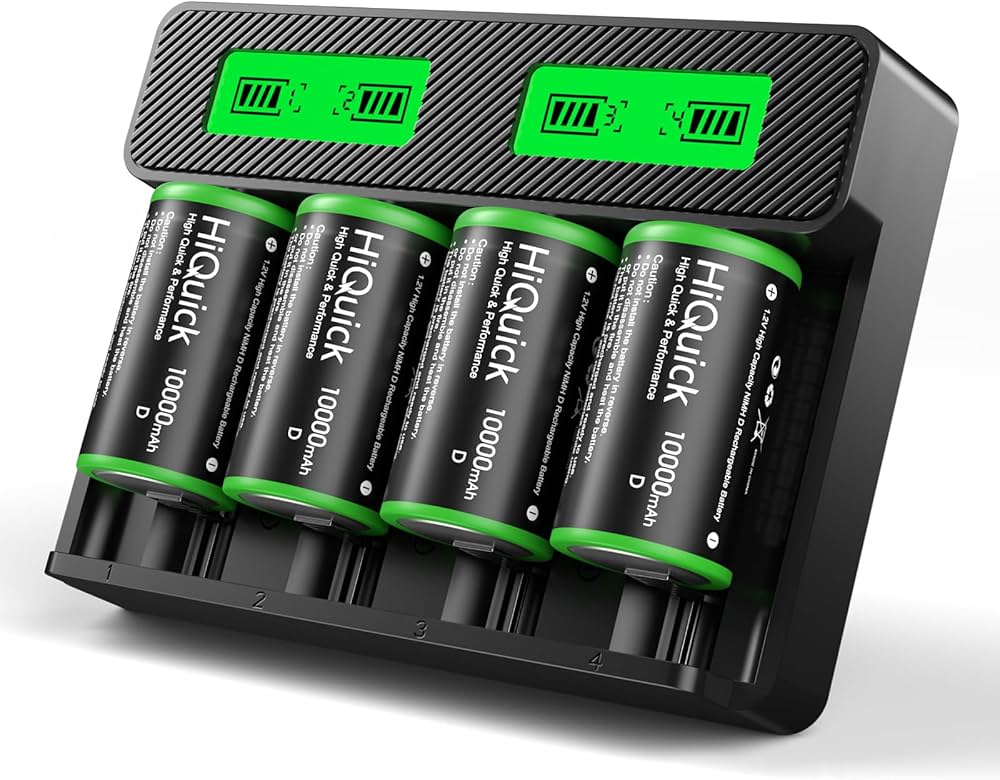
Rechargeable D batteries are large-format cells that can be charged and reused hundreds to thousands of times, unlike single-use alkaline batteries that are discarded after one use. When bundled with a compatible charger, they form a complete power system that lets you keep your devices running without constant trips to the store.
The D battery size — also known as IEC designation R20 or LR20 — is one of the largest common cylindrical battery formats. It measures 61.5mm in length and 34.2mm in diameter and is widely used in devices that demand sustained, high-capacity power output.
Most rechargeable D batteries today use one of three chemistries:
- NiMH (Nickel-Metal Hydride): The most popular consumer choice. Offers high capacity, low self-discharge, and no memory effect.
- NiCd (Nickel-Cadmium): Older technology. More durable in extreme temperatures but suffers from memory effect and contains toxic cadmium.
- Li-ion (Lithium-Ion): Rare in D-cell format for consumer use, but offers superior energy density and lighter weight.
The vast majority of rechargeable D batteries sold today are NiMH, and that’s what most of this article focuses on.
Why Rechargeable D Batteries with Charger Are Worth It
The Real Cost of Disposable D Batteries
Let’s talk numbers. A pack of 8 alkaline D batteries typically costs between $10 and $18. If you’re powering multiple devices and replacing batteries every few weeks, annual costs can easily reach $100–$300 per household.
By contrast, a quality set of rechargeable D batteries with charger costs between $25 and $60 upfront and can be recharged 500 to 1,000+ times, depending on the brand and chemistry.
Here’s a simple cost comparison:
| Battery Type | Upfront Cost | Lifespan | Estimated 5-Year Cost |
|---|---|---|---|
| Alkaline D (8-pack) | $12–$18 | Single use | $180–$450+ |
| Rechargeable D NiMH + Charger | $30–$60 | 500–1,000 cycles | $30–$60 total |
| NiCd Rechargeable D + Charger | $20–$40 | 300–500 cycles | $20–$40 total |
The savings are significant. Over five years, most households save $150 to $400 simply by switching to rechargeable D batteries with a quality charger.
Suggested read: Best Dodge Charger Tires: What Every Charger Owner Needs to Know in 2026
Environmental Benefits You Can’t Ignore
According to the EPA, Americans throw away approximately 3 billion batteries every year. D batteries, being larger, contribute more landfill waste per unit than AA or AAA cells. Heavy metals like mercury, cadmium, and lead can leach into soil and water systems.
Switching to rechargeable D batteries with charger means:
- Fewer batteries in landfills — one rechargeable cell replaces hundreds of disposables
- Lower carbon footprint over the battery’s full lifecycle
- Reduced demand for raw material mining
A 2020 study by the European Environment Agency found that rechargeable batteries have a carbon footprint up to 9x lower than disposable batteries when measured across their full lifecycle.
How to Choose the Best Rechargeable D Batteries
Capacity: mAh Matters More Than You Think
Battery capacity is measured in milliampere-hours (mAh). The higher the mAh, the longer the battery lasts per charge. For D batteries, typical capacities range from 2,000 mAh to 11,000 mAh.
Here’s what different capacities mean in practice:
| Capacity (mAh) | Best For | Estimated Runtime in Flashlight |
|---|---|---|
| 2,000–4,000 | Light-use devices, remotes | 4–8 hours |
| 4,000–7,000 | Radios, lanterns, toys | 8–15 hours |
| 8,000–11,000 | High-drain devices, emergency gear | 15–30+ hours |
Pro Tip: Many rechargeable D batteries are actually re-cased C or sub-C cells, especially cheap no-name brands. Always verify the actual cell capacity by checking independent reviews or teardown tests.
Self-Discharge Rate: Low Self-Discharge (LSD) Is Key
Standard NiMH batteries lose 1–2% of charge per day when not in use. That means a fully charged battery can be nearly dead after a few months sitting on a shelf.
Low Self-Discharge (LSD) NiMH batteries — like the Panasonic Eneloop Pro or Amazon Basics LSD — retain up to 70–80% of their charge after 12 months in storage. For emergency preparedness kits, flashlights, and backup devices, LSD batteries are a game-changer.
Charge Cycle Rating
Always check how many charge cycles the battery is rated for:
- Budget brands: 300–500 cycles
- Mid-range brands: 500–800 cycles
- Premium brands (e.g., Eneloop): 1,000–2,100 cycles
A battery rated for 1,000 cycles that you recharge once a week will last you nearly 20 years. That’s real long-term value.
Top Rechargeable D Batteries Available in 2026
1. Panasonic Eneloop Pro D-Size (via Adapter)
Eneloop Pro cells are widely regarded as the gold standard in rechargeable NiMH batteries. While they don’t manufacture a native D-cell, Eneloop Pro AA cells can be used inside D-size adapters — a popular workaround that combines top-tier cell performance with the D-size form factor.
Suggested read: Best Chromebook Charging Station for Schools, Offices & Homes (2026)
- Capacity: 2,550 mAh (AA cell inside D adapter)
- Charge Cycles: Up to 500
- Self-Discharge: Retains 85% after 12 months
- Best For: Precision users who prioritize cell quality over raw capacity
2. Tenergy Premium Rechargeable D NiMH Battery
Tenergy is a well-known brand in the rechargeable battery space, especially popular with hobbyists and professionals.
- Capacity: 10,000 mAh
- Voltage: 1.2V
- Charge Cycles: 500+
- Best For: High-drain devices, emergency flashlights, camping lanterns
3. EBL Rechargeable D Batteries
EBL offers one of the highest capacity D batteries on the market, making it a top pick for devices that need sustained power.
- Capacity: 11,000 mAh
- Charge Cycles: 1,200+
- Included Charger Option: Yes — available as a bundle with an 8-bay charger
- Best For: Households with multiple D-powered devices
4. Powerex MHRDC4 D-Size NiMH Rechargeable
Powerex is a professional-grade brand trusted by photographers, broadcasters, and emergency services.
- Capacity: 10,000 mAh
- Charge Cycles: 500+
- Best For: Professional environments, frequent heavy use
5. Amazon Basics Rechargeable D Batteries
For budget-conscious buyers, Amazon Basics offers a solid entry point into rechargeable D battery territory.
- Capacity: 10,000 mAh
- Charge Cycles: 500+
- Best For: Casual household use, starter kits
Choosing the Right Charger for D Batteries
Not all battery chargers support D cells. Many universal chargers are designed only for AA and AAA sizes. When shopping for a charger for rechargeable D batteries, here’s what to look for:
Key Charger Features
1. Compatibility with D-Size Cells This sounds obvious, but many “universal” chargers only handle AA and AAA. Verify the charger explicitly lists D-size support before buying.
2. Smart Charging Technology (Delta-V Detection) A smart charger monitors voltage and temperature to detect when the battery is full and automatically stops charging. This prevents overcharging, which degrades battery life significantly.
3. Independent Channel Charging Each battery bay should charge independently. This allows you to charge batteries of different capacities or charge levels simultaneously without affecting each other.
4. Charge Rate Control (Slow vs. Fast Charging)
- Slow charge (0.1C): Takes longer (10–14 hours) but extends battery lifespan
- Fast charge (1C): Charges in 1–3 hours but generates more heat and may shorten life if done repeatedly
5. LCD or LED Status Display A charger with individual charge status indicators lets you monitor each bay, detect bad cells, and ensure all batteries are fully charged before use.
6. Refresh/Discharge Function Some premium chargers include a refresh mode that fully discharges then recharges the battery. This restores lost capacity in older cells and is particularly useful for NiCd batteries prone to memory effect.
Suggested read: Exploring the Latest Market Trends in Automatic Charging Technologies for 2026
Top Chargers for Rechargeable D Batteries
| Charger Model | Bay Count | Charges D Cells | Smart Charging | Price Range |
|---|---|---|---|---|
| Nitecore D4 | 4 | Yes | Yes | $25–$35 |
| EBL 8-Bay Smart Charger | 8 | Yes | Yes | $30–$45 |
| Powerex MH-C9000 | 4 | Yes | Yes | $60–$80 |
| La Crosse BC-9009 | 8 | Yes | Yes | $50–$70 |
| XTAR VC8 | 8 | Yes | Yes | $35–$50 |
The Powerex MH-C9000 and La Crosse BC-9009 are consistently ranked as the best smart chargers for serious rechargeable battery users. Both offer individual cell monitoring, discharge/refresh cycles, and detailed readouts.
How to Use a D Battery Charger Correctly
Getting the most out of your rechargeable D batteries with charger requires proper charging habits. Here’s a step-by-step overview:
Step 1: Insert Batteries Correctly Align the positive (+) and negative (−) terminals with the charger’s markings. Reversed batteries can damage both the battery and charger.
Step 2: Select the Right Charge Mode If your charger has selectable charge rates, use slow charge (0.1C) for maximum battery longevity. Use fast charge only when you need batteries urgently.
Step 3: Allow a Full Charge Cycle For new batteries, complete a full charge before first use. Some manufacturers recommend running 2–3 full charge/discharge cycles to condition new NiMH cells and maximize capacity.
Step 4: Don’t Leave Batteries on Charger Indefinitely Even smart chargers with trickle charge modes can cause mild degradation over long periods. Remove batteries when fully charged.
Step 5: Store Charged Batteries Properly Store rechargeable D batteries in a cool, dry location away from direct sunlight. Ideal storage temperature is 50°F–77°F (10°C–25°C). Avoid storing in extreme heat or cold.
Rechargeable D Batteries vs. Alkaline D Batteries: A Deep Comparison
This is the question most buyers have before switching. Here’s a thorough head-to-head comparison:
| Feature | Rechargeable D (NiMH) | Alkaline D |
|---|---|---|
| Voltage | 1.2V | 1.5V |
| Capacity | 2,000–11,000 mAh | 12,000–18,000 mAh |
| Reusability | 500–2,100+ cycles | Single use |
| Self-Discharge | Moderate (LSD types: low) | Very low |
| Performance in Cold | Good | Poor |
| Cost Per Use | $0.01–$0.05 | $1.50–$2.00 |
| Environmental Impact | Low (long lifecycle) | High (landfill waste) |
| Shelf Life | 3–5 years (LSD types) | 5–10 years |
One important note: rechargeable NiMH batteries output 1.2V versus alkaline’s 1.5V. This small difference rarely causes issues in most devices, but some precision electronics or devices with low-voltage cutoffs may not function optimally. For 99% of household devices, 1.2V rechargeable D batteries work perfectly fine.
Real-World Case Study: Emergency Preparedness Kit
Scenario: A family of four in a hurricane-prone region maintains an emergency kit that includes two large LED lanterns, a hand-crank/battery-powered weather radio, and two heavy-duty flashlights — all requiring D batteries. Their previous approach used alkaline batteries replaced every six months.
Annual cost with alkalines: $72 (6 packs of 8 D batteries at $12 each)
Suggested read: 5 Municipalities Succeeding with Tyler Tech Solutions: A Case Study
After switching: They purchased a set of 12 EBL 11,000 mAh rechargeable D batteries and an 8-bay smart charger for a total of $68. They recharge using their home solar setup — for more on pairing solar power with battery charging systems, check out our detailed post on the rv solar battery charger.
Year 2 and beyond: $0 additional cost (batteries are still well within their rated cycle count). Estimated 5-year savings: $292.
Beyond cost, they noted that their emergency kit batteries were always ready because they adopted a habit of topping off the charge monthly — something that’s impractical with alkalines unless you want to waste partially-used batteries.
Common Mistakes to Avoid with Rechargeable D Batteries
Even experienced users make these errors. Avoiding them will dramatically extend the life of your batteries:
- Mixing old and new batteries: Always use batteries of the same age, capacity, and brand in multi-battery devices. Mismatched batteries cause uneven discharge and can reverse-polarity the weaker cell.
- Storing dead batteries: Always store batteries in a partially charged state (40–60%) if you’re not using them for extended periods.
- Using the wrong charger: Cheap, unregulated chargers can overcharge and destroy D cells. Always use a smart charger with Delta-V cutoff.
- Ignoring temperature during charging: Charging in extreme cold or heat reduces efficiency and causes cell damage. Charge at room temperature whenever possible.
- Over-discharging: Running batteries completely flat in high-drain devices repeatedly causes irreversible capacity loss. Remove batteries before the device signals “low battery.”
Where to Buy Rechargeable D Batteries with Charger
You can find rechargeable D batteries with charger bundles at the following retailers:
- Amazon — Largest selection, frequent bundle deals, competitive pricing. Shop rechargeable D batteries with charger on Amazon →
- Walmart — Good for in-store pickup and budget options
- Best Buy — Better for premium brands and charger accessories
- B&H Photo — Excellent source for professional-grade brands like Powerex and Maha
- Tenergy Direct — Manufacturer’s site with bundle deals not available elsewhere
When shopping online, look specifically for “rechargeable D batteries with charger bundle” to find sets that include both components at a better combined price than buying separately.
Frequently Asked Questions About Rechargeable D Batteries with Charger
Can I use any charger for rechargeable D batteries?
No. Not all chargers support D-size cells. Always verify that your charger explicitly lists D-cell compatibility. Using an incompatible charger can cause incorrect charging, battery damage, or even safety hazards. A smart charger designed for multiple cell sizes — including D — is your safest option.
How long does it take to charge rechargeable D batteries?
Charging time depends on the charger’s output current and the battery’s capacity. A 10,000 mAh D battery charged at 1A will take roughly 10 hours. High-speed chargers at 2A can halve that time. Most smart chargers automatically adjust the rate and time based on the battery’s current charge level.
Are rechargeable D batteries as powerful as alkaline D batteries?
Rechargeable NiMH D batteries output 1.2V compared to alkaline’s 1.5V, but they maintain more consistent voltage throughout their discharge cycle. Alkalines start at 1.5V but drop quickly, while NiMH holds near 1.2V until nearly depleted. In practice, most devices perform equally well or better with rechargeable D batteries.
How many times can I recharge rechargeable D batteries?
Quality NiMH D batteries from reputable brands can be recharged 500 to 2,100 times, depending on the brand and how well you maintain them. Budget batteries may be rated for fewer cycles. Following proper charging habits dramatically extends the cycle life of any rechargeable D battery.
What’s the best rechargeable D battery with charger for emergency kits?
For emergency preparedness, look for low self-discharge (LSD) NiMH D batteries combined with a smart charger. The EBL 11,000 mAh D batteries with their 8-bay smart charger bundle is a popular choice. Pair with a solar-compatible charging setup for true off-grid readiness.
Suggested read: Revolutionizing SP+Aff Charge Solutions with Advanced Technologies
Do rechargeable D batteries work in all devices that use regular D batteries?
Yes, in the vast majority of cases. The slight voltage difference (1.2V vs 1.5V) is not a problem for most consumer electronics, flashlights, toys, radios, and similar devices. A small number of very sensitive devices may not work as expected — check your device’s documentation if unsure.
Are cheap rechargeable D batteries worth buying?
Budget rechargeable D batteries often use lower-quality cells with inflated capacity ratings. Independent teardown tests frequently reveal that cheap “10,000 mAh” D batteries contain much smaller sub-C cells with actual capacities of 3,000–5,000 mAh. Spending a bit more on brands like EBL, Tenergy, or Powerex pays off in real-world performance and longevity.
Can I charge rechargeable D batteries with a solar charger?
Yes. Solar-compatible battery chargers exist and work well with rechargeable D batteries, especially for camping, RV use, or off-grid emergency setups. Ensure the solar charger outputs the correct voltage and current for D-cell NiMH chemistry. For more information on solar-powered battery systems, read our post on rv solar battery charger for practical pairing advice.
Citation & Sources
- U.S. Environmental Protection Agency (EPA) — Battery waste statistics: https://www.epa.gov/recycle/used-batteries
- European Environment Agency — Lifecycle carbon analysis of battery types (2020): https://www.eea.europa.eu
- IEC Standard 60086-2 — Battery size and designation specifications: https://www.iec.ch
- Panasonic Eneloop Product Specifications: https://www.panasonic.com/global/consumer/eneloop
- Amazon product listing for rechargeable D batteries with charger: https://www.amazon.com/s?k=rechargeable+d+batteries+with+charger
Ready to stop wasting money on disposable batteries? Browse the latest deals on rechargeable D batteries with charger and make the switch today — your wallet and the planet will thank you. Shop rechargeable D batteries with charger now →